


Shantanu Joshi
Sales head
How VRF System Works: Principles, Components & Applications Explained
Variable Refrigerant Flow (VRF) is a new HVAC-type technology available with proper zone-wise temperature control due to the dynamically variable control of the flow of refrigerant to the multiple indoor units. What is the working principle of the VRF system? Essentially, it operates by altering the circulating refrigerant on a real-time basis depending on the specific cooling or heating load of a zone so as to yield the highest energy efficiency and user comfort.
A great number of speculations exist concerning the difference between VRV and VRF systems. There is a lot of speculation around the distinction between VRV and VRF systems. Functionally speaking, it is all the same in the trade, although Daikin has trademarked the term VRV (Variable Refrigerant Volume) and the general term industry uses to describe the same technology is VRF (Variable Refrigerant Flow). The two terms are used to describe HVAC systems that decrease or increase the quantity of refrigerant instantly to satisfy the differing heating and cooling requirements within distinct regions.
In an era where building designs are shifting towards requiring energy efficiency and flexibility in climate control structures, VRF/VRV systems have become one of the most desirable systems to be used in commercial, industrial and residential properties.
VRF System Working Principle Explained
The VRF system working principle is associated with intelligent control of refrigerant flow to fulfil the precise cooling or heating demand of every zone. The core of this system is an inverter-driven compressor which constantly changes its speed to provide just enough refrigerant needed at any one instant.
As opposed to traditional HVAC systems, which operate in an on-off cycle, a variable refrigerant flow air conditioning system guarantees that the amount of refrigerant is controlled dynamically, eliminating energy losses. During periods of cooling, the compressor speeds up to allow more refrigerant through and during times of low demand slows down. This is to ensure precise temperature control and also to conserve energy by providing minimal power.
The effect of the VRF system’s working principle in a multi-zone application proves useful when different rooms or floors have different thermal loads. With the VRF system, each indoor device is supplied with the exact amount of refrigerant, handled by the use of electronic expansion valves (EEVs) and zone-wise sensors, and therefore achieves individual comfort in the respective zone.
Further, VRF systems have two main modes of operation:
- Two-Pipe Heat Pump System (VRF): An indoor system operates in either cooling or heating all at once.
- Heat Recovery Mode (three-pipe system or with branch selectors): Enables heating and cooling of different areas at the same time, and heat load of one area to another, hence increasing the efficiency of the system.
The VRF mechanical system promises comfort advantages, high energy efficiency, and extended service life by getting rid of the repetitive on-off swings and facilitating fine-tune refrigerant circulation.
VRF System Components & Their Functions
It is crucial to understand the critical VRF system components before understanding how all parts work together in sync to produce efficient climate control within zone-specific settings. So what constitutes the principal parts of a VRF mechanical system?
1. Outdoor Condensing Units
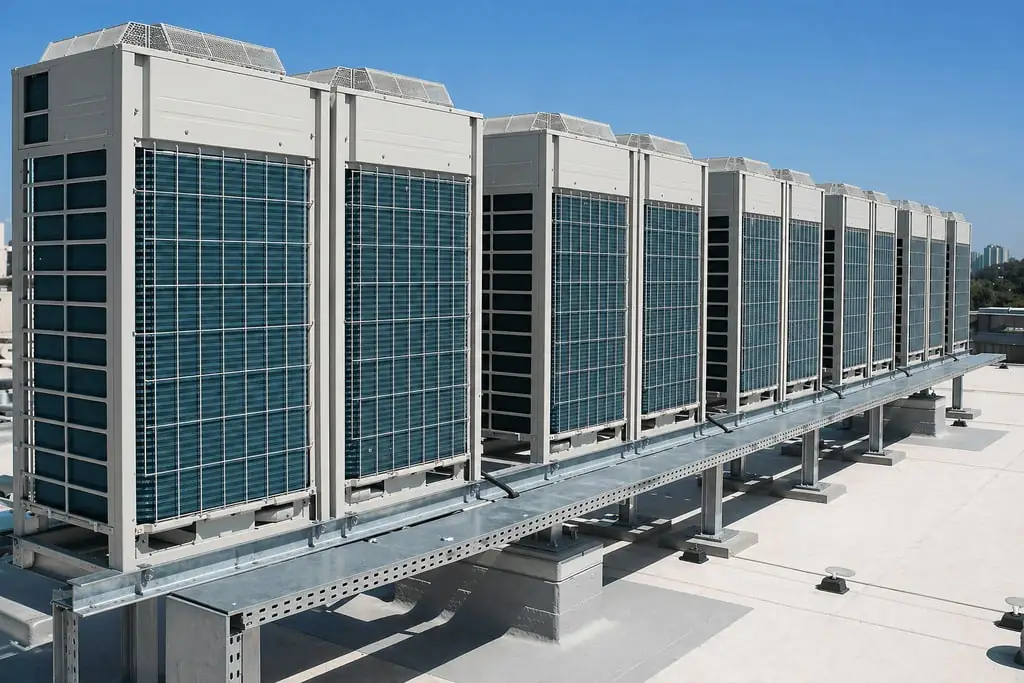
The outdoor section has the inverter-operated compressor, which handles the flow of refrigerant in real time. Depending on the cooling method (air-cooled or water-cooled), the outdoor unit emits heat that was removed from the interior space.
2. Indoor Fan Coil Units (FCUs)
These are indoor air-handling systems which vent refreshed air into specified areas. FCUs can be operated independently of each other so that the temperature of each room or area can be set individually.
3. Refrigerant Piping Network & Refnet Joints
VRF system takes advantage of a network of refrigerant piping that can connect outdoor units to numerous indoor units. The refrigerant lines are efficiently branched using Refnet joints (Y-shaped copper fittings) to avoid any flow changes due to the distribution of the refrigerant to different zones in an effective manner.
4. Branch Selector Boxes (For Heat Recovery Systems)
In heat recovery VRF systems, the branch selector boxes are important to enable multi-branch heating and cooling. These boxes regulate the direction of flow of refrigerant, which enables energy transfer between zones.
5.Electric Expansion Valves
EEVs are positioned at each indoor unit to regulate the amount of refrigerant entering the evaporator coils. EEVs offer optimal thermal comfort and energy efficiency across the whole zones as they allow the right amount of refrigerant to flow through.
6. BMS Integration & Centralized Control Systems
Newer VRF installations typically come with centralized controllers or can be integrated with Building Management Systems (BMS). This allows the facility managers to view and regulate the whole HVAC system via a central interface, facilitating a higher operational efficiency with enhanced predictive maintenance capabilities.
As a combination, all these components of VRF systems are designed to operate in a coordinated manner to provide a flexible, scalable, and energy-efficient moisture and climate control application to fit the multifarious applications.
VRF System Diagram with Explanation
To visualise the refrigerant flow and the way every component interconnects in a standard VRF installation, let us envision a typical VRF system diagram and clarify some of its key functional paths.
Simple Layout of VRF System
A typical diagram shows a VRF system:
- Outdoor condensing unit(s) with a network of refrigerant piping.
- VRF Joints (Y-branch connections) supply refrigerant to one or more indoor coils.
- Installed Indoor Fan Coil Units (FCUs) in various zones.
- Each indoor unit is equipped with Electronic Expansion Valves (EEVs) to ensure quality control of the refrigerant.
- Optional Branch selector box-type of heat recovery systems.
Refrigerant Flow Path Explained
The refrigerant, relayed by the outdoor unit, is subjected to variable flow by the inverter-driven compressor as required to provide cooling or heat to the system. The refrigerant is relayed to indoor units by Insulated copper pipes.
Every Refnet junction divides the refrigerant flow with precision, supplying each designated indoor fan coil unit exactly the volume it requires. Then, EEVs micro manage entry of refrigerant into the indoor coil, ensuring accurate temperature control.
Within heat-recovery systems, Branch Selector Boxes determine whether the refrigerant is directed to each zone in heating or cooling mode. Such a setup proves especially advantageous in buildings where separate areas call for simultaneous heating and cooling.
Variable Refrigerant Flow Air Conditioning System Efficiency
The key difference with the variable refrigerant flow air conditioning system is that it continuously modulates its flow, scaling refrigerant volume to every space or precisely to the thermal load of each space. This improves energy efficiency and occupant comfort and more versatile zoning without large ductwork.
Be it small offices, large commercial complexes, or residential VRF systems, such a design can be modular and scalable, fitting different types of building layouts.
Types of VRF Systems for Different Applications
Several variations of VRF can work well in different applications and suit different building requirements. The most widely spread are the following:
Heat Pump VRF Systems (Two-Pipe Configuration)
A heat pump VRF system uses a two-pipe system, one pipe liquid and one pipe gas, thereby requiring that all units are in the same mode (heating, cooling) at any one time. This is applicable in buildings that possess similar thermal loads across zones. A two-pipe VRF system is cheaper and easier to install, but lacks the flexibility of mixed-mode operation and should be used where spaces have similar heating or cooling requirements.
Heat Recovery VRF Systems (Three-Pipe or Branch-Circuit Systems)
On the other hand, heat recovery systems facilitate the simultaneous provision of heating and cooling to separate zones by capturing unneeded heat from one area and diverting it to warm another. Manufacturers such as Mitsubishi, LG, and Carrier attain the same outcome using a two-pipe branch circuit controller rather than a three-pipe system.
By harnessing branch selector boxes (or BC controllers), these systems redirect refrigerant where it is required, thereby greatly improving energy efficiency by reclaiming internal heat rather than allowing it to be wasted.
Hybrid VRF Systems
Hybrid systems offer a combination of refrigerant-based and hydronic (water-based) systems- using VRF outdoor units and coupling them with water coils or chillers to provide district-level thermal delivery. These integrated systems offer the scalable and modular structure of building solutions that include ducting water systems and the refrigerant-based zoning and only suit where there is a large building facility.
Residential vs Commercial Uses
- Residential VRF (e.g. villa, apartments) systems have small equipment indoors and feature low ductwork, so they are common in luxury residential homes and in multi-unit residential developments.
- Commercial VRF systems are very efficient in multi-zone office space, hotels, schools, hospitals, and retail centres as it is essential to have independent zone temperature control in such applications. They can be easily retrofitted or fitted out with little interruption due to their flexible installation option.
Summary Table:
System Type | Configuration | Simultaneous Heating & Cooling | Best For |
Heat Pump VRF | Two-pipe (liquid + gas) | No | Buildings with uniform load zones |
Heat Recovery VRF | Three-pipe or Branch Circuit | Yes | Mixed load buildings, zones require different modes |
Hybrid VRF Systems | Refrigerant + Hydronic | Yes | Large, complex, mixed-use projects |
Advantages of VRF Technology
Variable refrigerant flow HVAC system offers numerous benefits in terms of energy consumption and comfort as well as flexibility, thus, offering a versatile solution in both residential and commercial premises.
Energy Efficiency & Cost Reduction
Due to the inverter compressor, the system continuously regulates refrigerant flow rate based on the momentary demand, thus avoiding power surges and idle energy losses when using compressors. This could save between 30-40 percent of energy over other systems based on compressors with fixed speeds.
Heat recovery, VRF systems have additional savings due to heating and cooling between zones instead of losing heat to the outside and these systems provide an increased system performance.
Zoning Flexibility & Personalised Comfort
- Working independently, the indoor unit can enable those within any zone to control their temperature.
- It is also suitable for a wide variety of applications, including different rooms within a home VRF system, suites in hotels, or different zones in office buildings.
Compact Installation & Space Optimization
- VRF systems also do not require much or any ductwork at all, conserving building structural space and simplifying construction.
- The indoor units are compact and versatile (e.g. ceiling cassette, wall hung), which is ideal in residential VRF systems and retrofit installations.
Silent & User-Friendly Operation
- Outdoor units have comparatively low noise levels, and the indoor units are designed to be quiet and discreet in operation, increasing occupant comfort.
Smart Control & Enhanced Monitoring
- Smart systems may enable centralized control or BMS with remote monitoring and remote scheduling, diagnostics and notifications, and optimization of energy use using the principle of artificial intelligence.
- Several manufacturers offer IoT enabled applications and dashboards to monitor and analyze real-time data.
Easy Maintenance & Durability
- The accurate control of the refrigerant can reduce wear and ensure the longer life of the system, and reduce breakdowns.
- Because the system is zoned, maintenance can be localized Faults in the indoor units can be repaired without disrupting the entire system.
Applications of Variable Refrigerant Flow Systems
VRF system offers a customised HVAC performance in various settings, and it is quite versatile in both residential and commercial applications.
Commercial Buildings & Office Spaces
- Office buildings enjoy the advantage of accurate zoning, silence, and ease of installations, particularly where zones vary in occupancy and solar loads.
- Best suited to commercial property, such as hotels, retail stores, restaurants, and mixed/purpose complexes, where heating and cooling can be done simultaneously, to enhance guest comfort and energy savings.
Hotels & Hospitality
- Every room will be individually adjusted, allowing each consumer control their environment and be administered at distant locations through central facilities.
- Heat recovery VRF systems enable the different cooling or heating zones to be either cooled or heated separately, making it much more comfortable and less energy-consuming.
Residential & Multi-Family Housing
- Residential VRF systems such as villa or apartment units have compact installation and distributed units, suited to owner-occupied residential units or rental apartment blocks.
- Zoning flexibility with sizeable zones and compact ducting on indoor unit configurations by homeowners is a priority.
Educational, Healthcare & Institutional Facilities
- Modular zoning with the central system controls benefits schools, colleges, and campuses to simplify a variety of room types and schedule efficiently.
- Regulation of the temperature and the rate of ventilation within the patient rooms and common spaces, even concurring modes, can develop comfort and enhance the level of infection control within the hospitals and clinics.
Retrofitting & Historic Building Applications
- VRF systems have low ductwork requirements and very small piping, allowing them to be used with the minimum of architectural disturbance in heritage or retrofit work.
Specialized Facilities: Data Centers & Industrial Zones
- VRF systems also work in environments that require strict temperature control like server rooms, manufacturing plants, and laboratories, especially where micro-zoning and effective heat recovery can provide value.
VRF vs Mini Split: Comparison Table
The major difference between a VRF system and a mini-split system can help determine what to use when deciding between the two systems:
Feature | VRF/VRV System | Mini Split System |
System Scale | Connects to multiple indoor units (10–50+ zones). Ideal for large buildings. | Connects to 1–2 indoor units. Best for small spaces or single rooms. |
Zoning & Control | Advanced zone-wise control with precise refrigerant flow modulation per unit. | Basic zone control with on/off cycling. Limited modulation. |
Energy Efficiency | High efficiency (30–40% savings) due to inverter-driven refrigerant flow control. | Moderate efficiency improvement over traditional HVAC systems. |
Installation Complexity | Complex refrigerant piping with refnet joints and optional branch selector boxes. | Easy to install, with low amounts of piping, or without any mounting to a wall or ceiling. |
Flexibility & Scalability | Very scalable to major residential and commercial developments. | Limited to a few indoor units. Its multi-zone setup is not scalable. |
Cost Factor | Higher upfront cost and long-term operating costs and comfort. | A smaller upfront investment with less scope and scalability. |
Best Use Case | Offices, hotels and multi-family apartments, large houses requiring sophisticated zoning. | Single rooms, residential small areas, garage conversions, etc. |
Future Trends of VRF System
Based on current industry trends, the following are the main trends of the VRF technology future in 2025 and beyond:
Electrification and heat pump uptake
VRF systems are the building block of electrification and decarbonization of HVAC as all-electric heat pump solutions are gaining popularity in both commercial and residential markets. These systems provide precise zoning control
and compatibility with renewable energy inputs.
Shift to Low GWP Refrigerants
Recent regulations like the AIM Act of the U.S. require a gradual transition to low global-warming potential (GWP) refrigerants like R 454B and R 32 by 2026. VRF manufacturers are modifying devices to meet new safety standards and legally accepted refrigerants.
Smart Control, AI & Predictive Maintenance
With the help of AI-enabled systems and the IoT, VRF operations can be transformed:
- Human-in-the-loop systems regulate HVAC performance utilizing occupancy and energy pricing in real-time.
- Predictive maintenance will decrease downtime through advanced diagnostics.
- Real-time reinforcement learning based facility-wide optimization provides up to 37% energy savings with very modest comfort degradation.
Market Growth & Industry Momentum
The VRF systems market across the globe is growing fast. Market projections have estimated that the market will grow at a CAGR of more than 10% (taking 2025 as the base at around USD22.1 B), and reach between USD32 B by 2032-2035. A key driver is its growth in usage in residential, hospitality and mixed-use projects.
Hybrid VRF & Modular System Designs
The increasing trend to merge refrigerant with hydronic systems into hybrid platforms is opening up heightened flexibility for large-scale buildings and mixed-use developments. Outdoor units are compact and modular, and their scalable components simplify the installation and later expansion of the system.
Enhanced Indoor Air Quality & Energy Analytics
With increased significance in indoor air quality, new VRF systems come with superior filtration, air purification, and wellness capabilities. Remote monitoring platforms use energy usage and air quality indicators to control operations better.
FAQs
What are the components of VRV AC system?
There are several important parts of a VRV AC system, including:
- Outdoor unit (inverter-driven compressor)
- Several indoor fan coils (FCUs)
- Refrigerant piping system with Refnet joints
- EEVs on every indoor unit
- Branch Selector Boxes (heat recovery systems)
- Monitoring and control with centralised controllers or BMS.
How does a VRV system work?
By actively managing the refrigerant’s flow in real time, the VRV system fulfills each zone’s cooling or heating demand.
The compressor will have an inverter to vary the speed according to the load requirement and EEVs, sensors will also be used so that only the required amount of refrigerant reaches individual indoor units to have high energy efficiency and better zoning potential.
Which system allows simultaneous heating or cooling?
The Heat Recovery VRF system can be utilised in order to have simultaneous heating and cooling in various zones. This is achieved by a system of Branch Selector Boxes, which ensure refrigerant flow to heat or cool a zone with substantial energy savings and zones to suit individual tastes.
What is a VRF/VRV air conditioning system and its use?
A VRF/VRV air conditioning system is a higher-tech HVAC system that manages refrigerant directed to several internal units to achieve desired control in zones in terms of temperature.
Applications include:
- Offices and Cohousing offices
- Hotels, resorts and hospitality projects
- Multi-family apartments, villas
- Data centers, campuses, and hospitals.
How often should VRF systems undergo maintenance?
Maintenance of VRF systems is usually suggested thrice a year. Preventive maintenance involves cleaning of filters, checking refrigerants, inspection of valves, and testing of the electrical system. Routine servicing ensures that there is energy efficiency, the prevention of breakdowns and prolonging the life of the system.
What are LG VRF and Mitsubishi VRF systems renowned for?
Smart control features, energy analytics, and IoT integrations are famous attributes of LG variable refrigerant flow systems. VRF systems by Mitsubishi Electric have a reputation of being the innovators of hybrid VRF, providing simultaneous heating and cooling ability with high energy efficiency and efficient products.
Contact Form
Shantanu Joshi
Shantanu Joshi is a growth-focused Mechanical Engineer and business strategist, currently working as Sales Head at 227 Enterprise Pvt. Ltd., where he manages global sales, brand positioning, and international expansion with a strong focus on VRF Copper Joints (Refnet joints) and HVAC&R solutions. Connect with him to discuss practical HVAC&R market strategies, global business growth, and long-term opportunities.