


Shantanu Joshi
Sales head
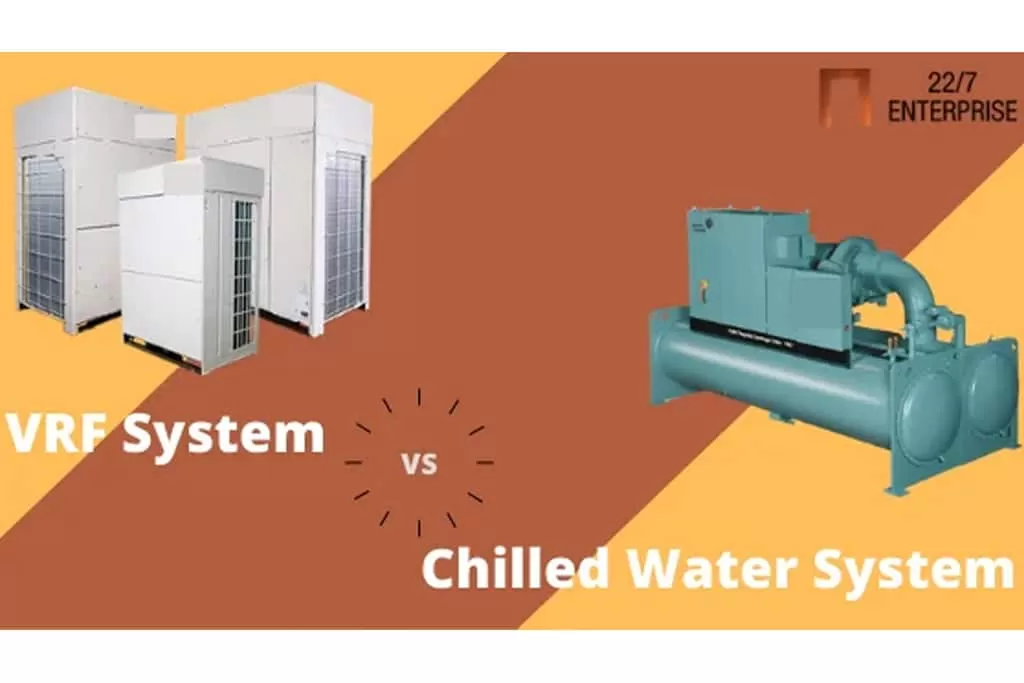
VRF System vs Chilled Water System: The Ultimate Difference Between:
One of the most important decisions in contemporary HVAC design is to decide to use a VRF System vs Chilled Water System. Both of the systems are designed to provide effective climate control in commercial, residential, and industrial facilities, but their main processes and usages are significantly different. With the building owners and HVAC consultants embarking on the ultimate match of VRF vs Chilled Water, the idea of the debate has never been so close to the truth.
Unlike a Variable Refrigerant Flow (VRF) system, which dynamically adjusts refrigerant flow to meet the precise cooling or heating requirement within particular zones, a Chilled Water System HVAC (Heating, Ventilation, and Air Conditioning) is based on the use of water as a cooling medium distributed by a piping network and AHUs and fan coils. The systems have distinct benefits and weaknesses regarding the scale of a building, design complexities, and costs.
This article is a comprehensive comparison between VRF vs Chilled Water, including its operating principle, cost aspect, performance aspect, and its empirical application in various projects. At the end you will have a clear view as to what solution best suits your project.
What is a VRF System?
A Variable Refrigerant Flow system (more commonly known as VRV cooling system) because VRV is a trademark of Daikin, and VRF is a generic term) is an advanced HVAC system that provides both heating and cooling by carrying refrigerant through one or more outdoor condensing units to one or more indoor units, each with independent controls. A VRF is not dependent on water-based cooling like the conventional chilled water system of an HVAC system.
The key components are inverter-driven compressors, networks of refrigerant pipes and individual indoor units. These compressors speed up or slow down to meet demand in zones, allowing them to ensure energy is accurately delivered and hence a high savings when partially loaded. Each outside unit is able to accommodate up to 64 unitary indoor units, which provides scalability and flexibility of modular installation, important features of the variable refrigerant flow format.
What is a Chilled Water System?
A chilled water system replaces a refrigerant circulating directly to indoor units with water as the cooling medium. A chiller in a typical air conditioning chiller plant provides relatively cold water, about 6–7 °C (42–45 °F). This chilled water is used to circulate to the cooling units like Air Handling Units (AHUs), Fan Coil Units (FCUs), through insulated pipes. The chilled water absorbs the heat in the indoor air in these units, thereby cooling the space. This warm water is directed back towards the chiller and cooled anew in a cycle.
Circulation (or distribution) of chilled water is facilitated by insulated pipes to water-based air conditioning systems, including AHUs and FCUs, where the water removes heat from the air inside buildings. This water, which has been heated, is then returned to the chiller to restore its coolness once again.
Key Components:
- Chiller: Operates as a chilled water generation unit with either vapour-compression or absorption refrigeration. Chillers may be air-cooled or water-cooled.
- Cooling Tower: In water-cooled systems, the cooling tower cools the condenser water loop. It may be viewed comparatively, like cooling tower vs. chiller systems, yet it is used in different ways.
- Pumps and Piping: Has chilled water pumps, condenser water pumps and sets of piping networks that are imperative to ensuring successful circulation of chilled and condenser water.
- Air Handling Units / Fan Coil Units: These units work by cooling and conditioning the air using chilled water coils, after which the air is circulated to other building zones.
- Optional Boiler: A chiller-boiler plant may be employed as the source of hot water to serve a separate space-heating hot-water loop in an integrated system.
How It Works:
- The chiller cools the water via a refrigeration cycle.
- The water is chilled in a network of insulated pipes delivered to the indoor units.
- That chilled water is used to cool indoor air via AHUs or FCUs.
- The heated water reverses course, returning to the chiller to repeat the cycle.
VRF vs Chilled Water Systems Differences:
| Feature | VRF System |
Chilled Water System |
|---|---|---|
| Cooling Medium | VRF with direct expansion (DX) system | Water chilled within an air conditioner chiller plant |
| System Type | Decentralised (localized indoor units connected by refrigerant pipes) | Centralised (chilled water system HVAC) supplying chilled water to AHUs/FCUs |
| Components | Outdoor condenser coils, refrigerant piping, and indoor fan coil units | Chiller, cooling tower (if water-cooled), pumps, insulated pipe, AHUs/FCUs |
| Installation Flexibility | Very modular, space-efficient, very little ducting needed | Requires a special plant room, large, lengthy pipework, and special mechanical spaces |
| Distance Limitation | Depending on model, piping may run up to 300–1000 ft | Can distribute chilled water over long distances using bigger pipes |
| Zoning Control | Excellent; each indoor unit is controllable separately | Moderate; dependent on HVAC design and zoning strategy |
| Energy Efficiency | Highest efficiency at part-load via inverter-driven compressors | More efficient for large, consistent loads; slower to respond to load changes |
| Heat Recovery | Available with a 3-pipe system (simultaneous heating and cooling) | Rare and complex in typical chilled water layouts |
| Maintenance Complexity | Easier; fewer moving parts and no water treatment needed | More complex; includes chillers, pumps, and requires water treatment |
| Repair Impact | Failure of the outdoor unit can affect multiple zones | With good zoning, localized faults (e.g., in FCUs) don’t impact the entire system |
| Initial Cost (CAPEX) | Lower for small-to-medium projects | High, but modular chiller plants can reduce CAPEX for phased development |
| Operating Cost (OPEX) | Low to moderate; load-dependent | Higher due to water treatment and pumping; efficient at high loads |
| Lifecycle Cost | Lower in small and medium-sized buildings | Lower in large complexes with continuous operation |
| Best Application | Hotels, office buildings, apartments requiring zoning adaptability | Commercial centers, malls, hospitals, universities, industrial plants |
| Modular Adaptability | Easy to expand with more outdoor/indoor units | Possible with modular air-cooled chillers, though space-intensive |
| Biggest Limitation | Limited peak capacity compared to large-scale chiller systems | Suited for extreme cooling demands, backed by large central chillers |
Chiller vs AC: How Are They Different?
In discussing Chiller vs AC, it is worth noting the differences in their working mechanisms, their available capacities, and their optimal applications in HVAC.
Mechanism & Medium
- A direct expansion air conditioner (AC) can be defined as a system that cools air directly through the use of a refrigerant such as Freon in a single-zone cooling mechanism.
- A Chiller is a machine that operates in an air conditioner chiller plant, where heat is extracted by using vapour-compression refrigeration or absorption refrigeration cycles. Chilled water is run in pipes to AHUs or FCUs to cool the air indoors.
Scale & Cooling Capacity
- Chillers are designed to handle very large cooling loads- usually tens of kilowatts to multi-megawatt systems. Some chillers achieve powers of up to 21 MW.
- Conversely, individual AC units are to be placed in smaller areas. Chillers have even greater scalability and efficiency in larger facilities where centralized cooling is needed.
Energy Efficiency & Operating Profile
- Chillers are likely to be more energy efficient when dealing with large scale sustained cooling requirements, where the designs can be centralized and the systems may use a cooling tower vs chiller cooling rejection system.
- Conventional AC systems (unitary or split-type) are not as efficient at scale and are normally not designed to properly perform centrally or in zones.
Cost Implications
- Basic AC installations are cheaper at the beginning to be successfully implemented in residential or small commercial areas.
- Chillers are more expensive to install (chillers, pumps, piping, towers), especially in a chiller plant, although they are cost-effective at scale, especially when larger structures have longer lifecycles.
Maintenance & Complexity
- AC systems are comparatively simple, and have limited moving parts and reduced maintenance requirements.
- Chiller systems are more sophisticated, where water is treated, pumps, towers, and centralised infrastructure are involved. They also need experienced technicians in their maintenance.
Project Suitability: Which System Fits Your Building?
This is an optimized guide on deciding to use a VRF system or chilled water system HVAC based on the size of the architectural project, the type of building and the operation requirements:
When to Choose a VRF System
Small to Medium Buildings
VRF excels with office buildings, boutique hotels and apartments where zoning flexibility is most important and where modular installation is desirable. They are also very suitable where there is a necessity to use variable refrigerant flow capability.
Zone-based Comfort Control
VRF provides excellent control when individual temperature setpoints in individual areas are needed, with individual indoor units controlling their thermal zones.
Tight or Difficult Spaces
The small proportions of copper refrigerant piping, including a smaller outdoor footprint, make VRF particularly suited to retrofits and any mechanical space-constrained installations.
Moderate Cooling Load Profiles:
VRF inverter drive could consume considerably less power, especially in power-cycle projects, where part-load unit efficiency is an important concern.
When to Opt for a Chilled Water System
Large Scale Projects
University campuses, malls, hospitals, large institutional buildings, which have high and sustained chilled water cooling loads, are served well with the central chilled water infrastructure that relies on large-tonnage chillers.
Long-Distance and High Capacity Cooling
Chilled water systems may serve large buildings with long piping systems and strong distribution, where VRF piping distances or amounts of refrigerant are inadequate.
Effective Lifecycle Costs of Constant Loads
Although the air conditioner chiller plant may initially cost more to install, its greater COP and reduced operating cost at full load can deliver a strong ROI in the enormous building long run.
Staged Plant Increase
Installation of a modular chiller plant, especially in air cooled modular chillers or water cooled modular chillers, will allow adding the capacity to a phase of the project resulting in efficiency and reduced downtimes.
Pros and Cons: VRF System vs Chilled Water System
VRF System Advantages
- Impressive energy efficiency during partial-load operation is enabled by Variable Refrigerant Flow technology, allowing up to 55 % energy savings relative to traditional constant-capacity systems.
- Leveraging a compact design and diminished mechanical footprint, it requires only minimal ductwork or piping, making it ideal for retrofit as well as constrained installations.
- Enhanced zoning control via independent operation of each indoor unit per zone.
- Within many systems, heat recovery is a feature that allows the simultaneous provision of cooling and heating, thereby enhancing overall performance.
- Reduced on-site maintenance—fewer outside components and more straightforward pipework than in a centralized chilled-water plant.
VRF System Disadvantages
- Scalability limitations: The scalability of the piping limits and system capacity can restrict applications in very large buildings.
- An involved system of refrigerant pipes needs competent installation and will be more prone to leakage.
- Comprehensive calibration of the system control can be intimidating; a configuration error will decrease the performance.
Chilled Water System Advantages
- Best-suited to high-capacity loads with the central, high-capacity plant (largest chiller) and long run distances of the chilled water.
- Modular Chiller Plant packaged (both modular air cooled chiller or modular heat pump chiller banks) has precision load matching, redundancy, and distributed installations.
- Long lifecycle and more reliability in large installations; modules can isolate failures so that the system does not necessarily have to shut down.
- Complex solutions such as air-cooled modular chillers save footprint, installation time, and onsite complexity and enable hot-water production in heat-pump formats.
- Effective heat rejection in combination with the use of the cooling tower vs chiller systems, which meant the improvement of COP performance of large facilities.
Chilled Water System Disadvantages
- Increased initial cost (CAPEX) with infrastructure such as chillers, air conditioner chiller plant, piping, pumps, towers, and AHUs.
- Needs significant mechanical area (plant rooms, risers) and design of water treatment and distribution.
- Higher maintenance: Water treatment, pump support and cooling tower maintenance must be maintained.
Environmental and Energy Efficiency
- VRF systems, as a result of inverter-driven compressors and adaptive controls, work efficiently even at part-load using considerably less energy than the traditional fixed-speed systems. Under similar circumstances, they may record as much as 55% energy savings compared to conventional systems.
- In large-scale and continuous-load applications, chilled water systems, especially water-cooled chiller plants, provide better-than-average efficiency. It usually has a better COP than air-cooled VRF systems and seasonal efficiency.
Efficiency Comparisons & Real-World Results
- In a controlled study, VRF systems reduced about 30-35% of energy consumption in contrast to centralized chiller/ boiler systems in a humid subtropical and tropical climate.
- Water-cooled VRF-HP (heat pump) systems showed a further reduction, whereby the cooling energy consumption would be up to 15% less than that of conventional AHU-based chilled water systems.
- Heating-dominated climates often provide better performance of ground-source heat pumps, featuring energy savings as high as 44% or even more, although VRF exhibits a high efficiency even in mixed or cooling-dominant conditions.
Environmental Considerations & Future Trends
- Coefficient of Performance (COP) is a significant performance indicator: Although the VRF and chiller systems can easily exceed a COP of 3-5, COP is related to delta T and to ambient conditions.
- VRF systems introduced heat recovery in 3-pipe designs, allowing concurrent cooling and heating and thus can potentially save considerable energy consumption in multi-zone conditions.
- Modular chiller plant rundowns, such as modular air cooled chiller or heat pump chillers, allow a tight fit among capacity and demand and redundancy and freedom to expand in phases, all without compromising efficiency across other load profiles.
- New sustainability needs and eco-design pressures are driving HVAC solutions toward higher-COP, lower-refrigerant-charge and smarter-controlled systems. A hybrid solution such as deploying VRF in localized zones with central chilled water in highly demanding areas, is starting to attract attention due to the energy and emissions footprint.
Indoor Air Quality (IAQ) Considerations
VRF Systems & IAQ Limitations
- VRF systems mostly distribute conditioned air through indoor fan coil units, and thus need additional fresh-air provision (typically through standalone AHUs or more modern MVHR systems) to provide ventilation and filtration, and avoid ventilation and filtration problems.
- Although the Variable Refrigerant Flow technology is optimal in zonal temperature regulation, it does not inherently control fresh-air intake and air filtration, which need to be supplied externally to achieve good IAQ.
Chilled Water Systems & IAQ Strengths
- A complete HVAC Chilled water system features central chilled water air conditioning (AHUs or FCUs) with which the systems may ventilate, filter and control humidity.
- The air conditioner chiller plan acts as the centre cooling source, but exceptional IAQ gains are achieved by AHUs having filters, UV cleanliness and humidification/dehumidification capabilities.
- The centralised system solidifies constant handling of air, simpler care of the filtration systems and improved control of in-building air amounts, notably in delicate structures, such as hospitals or laboratories.
CAPEX vs OPEX – Financial Perspective
What Are CAPEX and OPEX?
Capital Expenditure (CAPEX) signifies the initial investment that is necessitated to obtain and set up the mechanical infrastructure/infrastructures as compressors, chillers, and chill water boilers, the installation cost of the piping, AHUs and auxiliary equipment.
Operating Expenditure (OPEX) comprises interests, electricity, water treatment and regular expenses incurred during yearly servicing and maintenance of the system throughout its life.
An effective life-cycle cost analysis (LCCA) will take into account the amount of CAPEX and the OPEX to generate a total ROI based on the estimated life of the system.
Capital Cost Comparison
A conventional 1200 RT project can experience a water-cooled chilled water system that is roughly 10% higher in initial CAPEX than a Variable Refrigerant Flow air-cooled system.
| System Type | Approx. CAPEX |
| Air-cooled VRF System | Lower total cost (e.g. $1,149,200 USD) |
| Water-cooled Chilled Water Plant | ~10% more (e.g. $1,276,200 USD) |
The variation comes about subsequent to extra infrastructure provisions such as an air conditioner chiller plant, cooling towers, water chillers, pumps, AHUs and piping.
Operating Cost Over Time
The OPEX accordingly reveals:
- Air-cooled VRF gives an annual operating cost that is about 15% higher than water-chilled HVAC systems, mostly because of electricity, maintenance, and no water-usage savings.
- Real term annual operating cost may be ~61,500 USD extra with air-cooled VRF vs ~390,200 USD total with water-cooled chilled water system.
Payback & Lifecycle Cost Analysis
Although CAPEX is higher, ROI can be reached at approximately 3 to 5 years in large scale projects because of the reduced annual OPEX. VRF systems, less costly in CAPEX, can also achieve longer break-even times in heavy-use applications.
LCCA is necessary to compare total costs over a standard life-span period of say 20-30 years, which incorporates items such as replacement parts, depreciation and residual value. Scrub that with load profile modelling and at least find the least-cost lifecycle option.
Future Trends & Hybrid Solutions
With the change in the HVAC industry, the argument of VRF System vs Chilled Water System is still influencing the design approach to a project. As demands increase on energy saving, the possibility of modular up and down flexibility, and sustainability, hybrid structures that unify the functions of both systems are becoming the standard in tricky building applications.
Hybrid HVAC Configurations: VRF vs Chilled Water
Combining VRF zoning with a centralized chilled-water system is becoming a widely adopted configuration for mixed-use high-rise and large facility commercial centers. This VRF vs Chilled Water solution enables:
- Variable occupancy spaces (such as off-text channels, hotel guest chambers, or residential spaces) with individualised control of temperature with flexible choices (utilizing Variable Refrigerant Flow (VRF) technology).
- Humidity and cooling of common, large volume areas through the use of centralised chilled water air conditioning units which are connected to an effective and high-capacity air conditioner chiller plant.
Modular & Scalable Cooling Solutions
Increased modular chiller plant installation regularly engaging modular air cooled chiller systems, has transformed scalability and redundancy. Such modular systems are suitable for:
More Phased Capacity Additions
- Preventing full-system shutdown by isolating faults.
- Replacement of equipment and easy maintenance in the long-term.
Another common use of chiller boiler system configuration in hybrid projects is the ability to combine heating needs that are centralized with cooling services further enhancing energy efficiency and space optimization.
Sustainability & Advanced Technologies: Heat Pump vs VRF
Heat pump vs VRF strategies Systems that employ such a diverse heat pump vs VRF strategy (e.g. heat-pump chillers and VRF used together to zone) see dual mode operation, allowing heating and cooling throughout the year, but with higher COP ratings.
Moreover, cooling tower vs chiller amalgamations are expounded to fine tune water-side productivity in large focalized systems, further lessening operating cost and fumes.
Conclusion
VRF System vs Chilled Water System is no longer an either-or decision. Nowadays, hybrid systems are gaining popularity. Comparison between VRF vs Chilled Water tends to be more on the side of flexibility and sustainability of workflow. Variable Refrigerant Flow systems are now preferred in design where individualized comfort levels are required, but Chilled Water System HVAC systems in combination with Chilled Water Air Conditioning Units are an efficient solution where large-volume areas are involved. Modular Chiller Plant and Modular Air Cooled Chiller solutions can easily scale capacity and expand through multiple phases providing reliability without compromising ROI.
Future-proof buildings combine Heat Pump vs VRF systems of heating and cooling, frequently as part of Chiller Boiler System metrics, or augmented with Cooling Tower vs Chiller optimization. Focus on energy mindful systems is long term sustainability and operation cost savings. With the maturity of such technologies as intelligent controls, low-GWP refrigerants, and hybrid VRF systems, the largest chiller systems are modularised, flexible, and more energy-efficient. The final step, of the right mix, provides the best CAPEX, OPEX and occupant comfort that responds to varied project requirements.
FAQs
1. What is the difference between FCU vs VRF?
An FCU (Fan Coil Unit) is a terminal device that heats or cools air in a zone, and is normally a component of a building-wide chilled water system HVAC. Conversely, a VRF (Variable Refrigerant Flow) system delivers refrigerant directly without the use of water, directly to indoor units, and allows zone-wise temperature control. Comparisons between FCU vs VRF point out that FCU have to be connected to an entire chiller or boiler and VRF systems are much smaller and decentralized can be used in multizone.
2. What is retrofitting of a chiller, and when is it necessary?
Chiller retrofitting involves upgrading the components or control systems of an existing chiller plant to increase efficiency or bring it into compliance with more current refrigerant regulations, or extend the lifecycle of an existing chiller plant. This is often done once older systems experience rising maintenance costs, power-wasting consumption, or are required to switch over to environmentally friendly refrigerants via newly imposed environmental regulations.
3. What is the difference between Air Chiller vs Air Conditioner?
Water passing through an air chiller is circulated to air handling units (AHUs) or a fan coil unit (FCUs) and used to cool spaces, making it perfect in large buildings. An air conditioner (split AC or packaged unit) directly conditions air with the help of refrigerants and is more applicable to small independent spaces. Air chiller vs air conditioner comparison in large-scale practice tends to favor air compressors for overall cooling and centralized cooling systems, air conditioners are immature in large-scale cooling.
4. Are VRV and VRF Different or Just Different Names for the Same System?
Yes, VRV (variable refrigerant volume) and VRF (variable refrigerant flow) are identical HVAC technologies. VRV is a Daikin trademark and other manufacturers in the industry refer to it as VRF. These systems are capable of real-time refrigerant flow to cool or heat individual zones, and this ability makes such systems energy-efficient climate control solutions without using water as a medium.
4. Is a Chiller System or VRF better to install on large buildings?
A chilled water system HVAC is easily tailored to large buildings that have a continuous cooling load, since it is comparatively more scalable and centrally controlled, and is relatively cheaper in the long-term OPEX. But VRF systems are beneficial in applications that demand highly versatile zone control, retrofit applications, or where performance at part-load is crucial. Large facilities also use hybrid solutions as a combination of chiller systems to cool core areas and VRF to cool perimeter areas.
Contact Form
Shantanu Joshi
Shantanu Joshi is a growth-focused Mechanical Engineer and business strategist, currently working as Sales Head at 227 Enterprise Pvt. Ltd., where he manages global sales, brand positioning, and international expansion with a strong focus on VRF Copper Joints (Refnet joints) and HVAC&R solutions. Connect with him to discuss practical HVAC&R market strategies, global business growth, and long-term opportunities.